
How to Get Your Business Recommended by ChatGPT: A Guide for Australian Small Businesses
Ask ChatGPT for the best plumber in Geelong or a good accountant in Box Hill, and it will name a few businesses. You get a short list with a reason for each one, instead of a page of links.
If your business is not on that list, the buyer may never see you, and more Australians are asking every month. Roy Morgan research found 10.5 million Australians used ChatGPT in an average four weeks in early 2026. That is 45% of people aged 14 and over.
The good news is that ChatGPT does not pick businesses at random. It looks for businesses it can find, understand and verify across the web. This guide walks through the steps we use at Go Click On to help small businesses get named in AI answers. You do not need a big budget, just clear, accurate facts kept consistent everywhere online.
|
QUICK ANSWER To get your business recommended by ChatGPT, make it easy for AI to find, read and trust you. Allow OpenAI’s search crawler on your site, and write clear service pages that name your suburbs, prices and credentials. Add schema markup and complete your Google Business Profile. Keep your name, address and phone the same on every directory. Earn steady, detailed reviews and get mentioned on trusted Australian sites. Then test real customer prompts each month. |
KEY TAKEAWAYS
- ChatGPT recommends businesses it can check across many sources. Self-praise on your own site counts for little.
- 10.5 million Australians use ChatGPT, and AI search visitors convert at up to 4.4 times the rate of organic visitors.
- 86% of AI citations come from sources a business controls, mainly its website and directory listings.
- Allow OAI-SearchBot in robots.txt and your firewall. Blocking GPTBot does not remove you from ChatGPT search.
- Matching name, address and phone details on Google, Yellow Pages, TrueLocal and industry sites build AI trust.
- Recent, detailed reviews and mentions on trusted Australian sites carry more weight than any claim you make.Live search can pick up fixes
- within weeks. Steady visibility usually takes three to six months, and no one can sell you a spot.
Why ChatGPT recommendations matter for Australian small businesses
Search habits are shifting. People still use Google, but many now start with a question in ChatGPT and ask for a shortlist with a reason to choose.
Roy Morgan puts ChatGPT well ahead of other AI tools in Australia. It is more than twice as popular as the next tool, Google Gemini. Use is highest among people aged 25 to 49, the group most likely to be running households, hiring tradies and starting businesses.
These visitors also tend to be ready to act. A Semrush study found the average visitor from AI search was worth 4.4 times more than a regular organic visitor, based on conversion rates. They arrive having already compared options inside the chat.
For a small business, one AI mention can be worth more than a page of rankings, which also means missing out costs more.
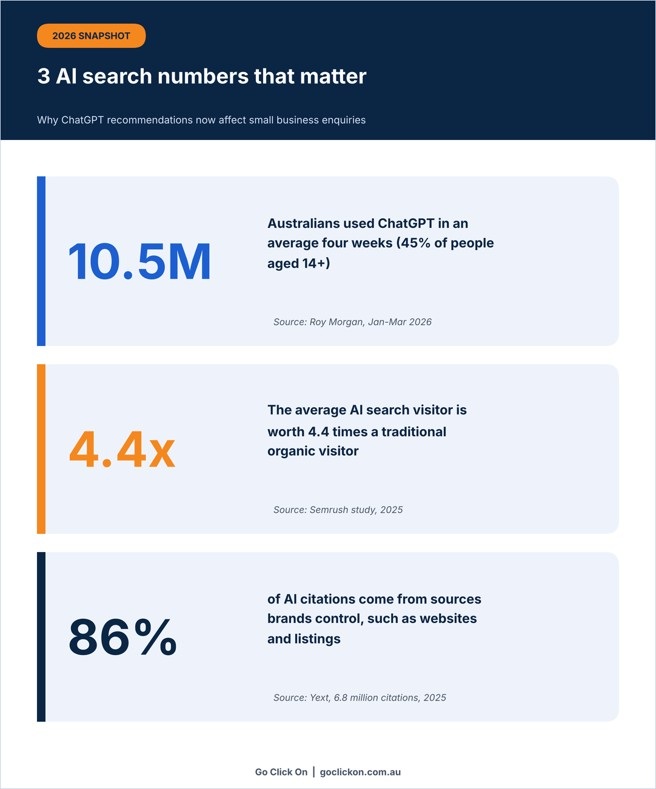
Quick takeaway: AI answers reach millions of Australians, and the people who click through are usually close to buying.
How does ChatGPT decide which businesses to recommend?
ChatGPT builds answers in two ways. It draws on what it learned in training, and for most local or current questions it also runs a live web search and reads the pages it finds. That live search step is where small businesses can make the fastest gains.
When it searches, ChatGPT is looking for a business it can recommend with confidence. It checks that the business is real and offers the exact service asked about in that area, then weighs what other people say about it.
Consistency matters here. If your website lists one suburb and your directory listing shows another, the AI has less reason to trust either source.
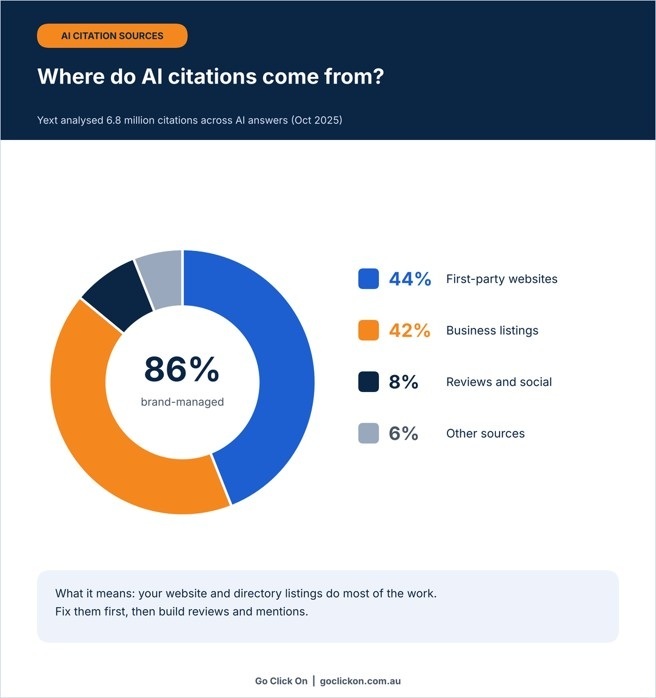
The sources matter too. Yext analysed 6.8 million AI citations and found 44% came from first-party websites and 42% from business listings. Reviews and social posts made up 8%. So 86% of what AI cites comes from places a business can manage itself.
The three kinds of ChatGPT questions
Not every prompt works the same way, so it helps to sort them into three groups.
- Branded questions, like “What does [your business] do?” Here you want ChatGPT to describe your business correctly.
- Research questions, like “How much does a new website cost in Melbourne?” Here you want your content used as a source.
- Recommendation questions, like “Best cafe fit-out builder near Richmond.” Here you want a place on the recommended shortlist.
Each type needs a slightly different fix, so track them separately.
Quick takeaway: ChatGPT favours businesses whose facts line up consistently across their website, listings and reviews.
Is getting recommended by ChatGPT different from SEO?
Partly. Good SEO gives you a strong base, because ChatGPT search leans on the same crawlable, well-built pages that Google likes. The goal is different, though, because SEO wins a ranking position. AI optimisation, often called GEO or AEO, wins a mention inside an answer.
Here is how the two approaches compare side by side.
| Factor | Traditional SEO | ChatGPT and AI search (GEO) |
| Main goal | Rank high in Google results | Get named and cited in AI answers |
| What the user sees | A page of links | A short list with reasons |
| Key signals | Backlinks, keywords, page speed | Clear facts, matching listings, reviews, third-party mentions |
| Best content style | Keyword-led pages | Direct answers, specific details, FAQs |
| Crawlers to allow | Googlebot, Bingbot | OAI-SearchBot, plus Googlebot and Bingbot |
| How to measure | Rankings, clicks, traffic | Prompt tests, citations, AI referral visits |
| Can you pay for a spot? | Yes, through Google Ads | No paid spot inside an organic answer |
| Typical time to results | 3 to 12 months | Weeks for live search, months for steady visibility |
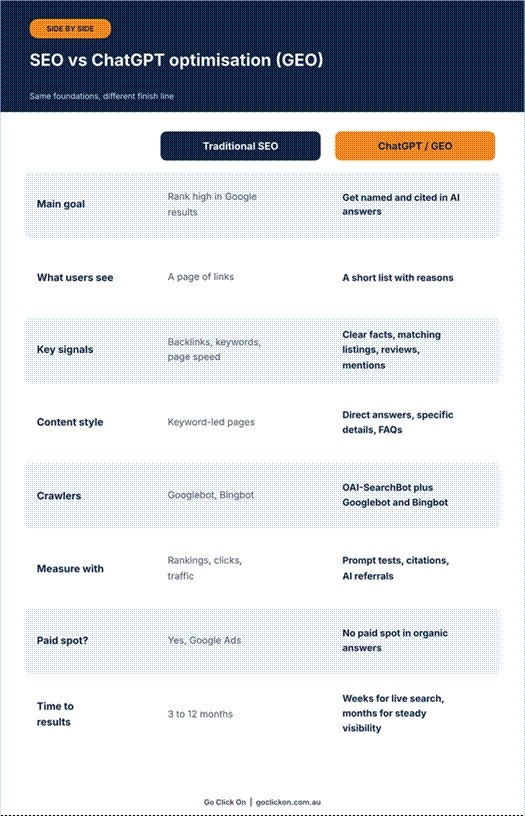
The overlap is good news. Most of the work you do for ChatGPT also helps you in Google AI Overviews, Perplexity and Gemini.
Quick takeaway: Treat SEO as the foundation and GEO as the layer that gets you quoted.
How to check if ChatGPT already recommends your business
Before you change anything, record a baseline. Open ChatGPT in a private window, logged out if possible, so your previous chats do not influence the answer. Then ask 10 to 15 questions that a real customer would typically ask.
Mix the three question types and add your suburb or city to the local questions, for example:
- “Who are the best [your service] providers in [your suburb]?”
- “What does [your business name] do, and what do customers say about it?”
- “How much does [your service] cost in [your city]?”
- “Compare [your business] with [a competitor].”
Record the date, the exact prompt, whether your business was named and which sources ChatGPT linked to. Run the same checks in Google AI Overviews and Perplexity, then open each source. If an outdated directory listing shows the wrong phone number, that is the first thing to correct.
Quick takeaway: Save your first results, because you cannot improve AI visibility you have not measured.
8 steps to get your business recommended by ChatGPT
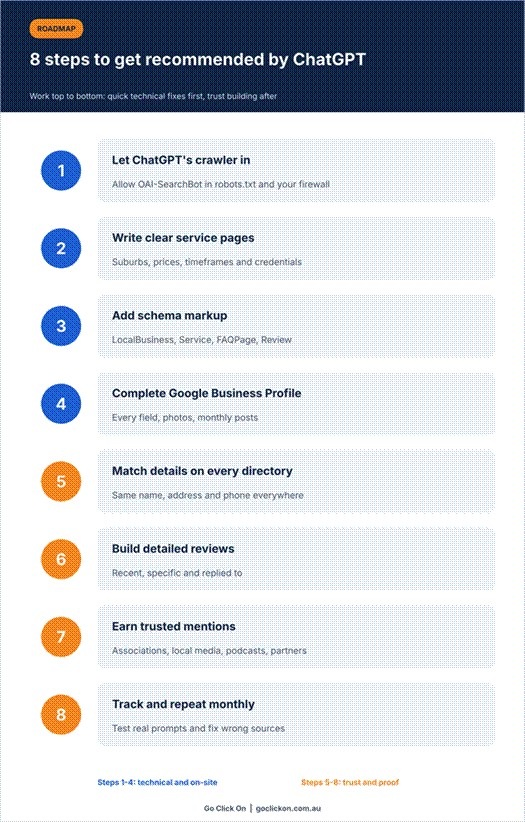
These steps run from quick technical fixes to slower trust building, so work through them in order.
Step 1. Let ChatGPT’s crawler reach your site
OpenAI uses different bots for different jobs. OAI-SearchBot finds pages for ChatGPT search, GPTBot collects content for model training, and ChatGPT-User visits a page only when a person asks it to.
To appear in ChatGPT search, OAI-SearchBot must be allowed. You can still block GPTBot if you do not want your content used for training, because OpenAI treats each setting independently.
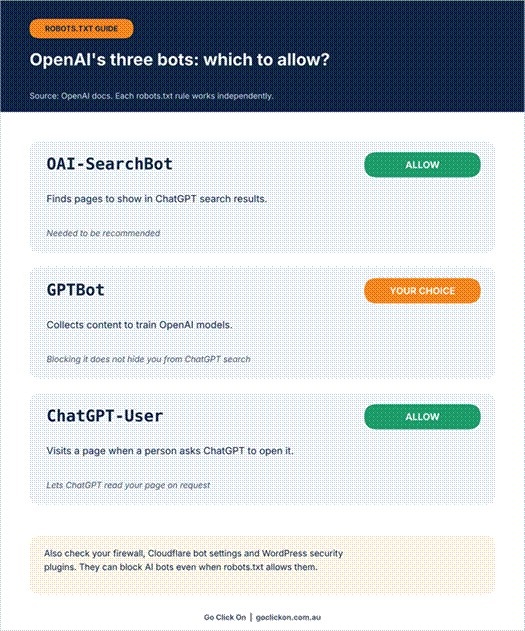
Check two places, your robots.txt file and your security layer. Firewalls, Cloudflare bot rules and some WordPress security plugins block AI bots by default, and we see this often in site audits. The fix is usually quick, but never switch off security to make it.
ChatGPT search also draws on third-party search providers, so add your site and sitemap to Bing Webmaster Tools. If your pages rely on heavy JavaScript to display text, ask your developer to render key content on the server, because many bots do not run scripts.
Step 2. Write service pages that answer real questions
Vague pages give AI nothing to quote, and a line like “We deliver quality solutions” tells ChatGPT nothing. “We install split system air conditioners in Ballarat, from $1,800 including a standard install” gives it facts to use.
Create one clear page for each main service, with a short, direct answer near the top. Then explain what you do, where you work, who it suits and what it costs, even if only as a range. Add typical timeframes and your licences or credentials.
Use headings that match how people ask, like “How much does a bathroom renovation cost in Geelong?” Keep paragraphs short and add a small FAQ with the questions customers ask you on the phone. Use Australian terms and the real suburbs you service. If you have your own data, like average job times or local price trends, publish it, because AI values facts it cannot find anywhere else.
Show who is behind the business too, since named staff with real experience give AI a person to trust. If your current site cannot support this kind of structure, a website built for search may be worth it.
Step 3. Add schema markup
Schema is structured code that labels the facts on your page so machines read them correctly. It tells AI that a number is your phone and that a suburb is your service area.
Start with LocalBusiness, or a more exact type like Plumber or Dentist, then add Service, FAQPage and Review schema where they fit. On WordPress, Yoast or Rank Math can handle most of it. Test each page with Google’s Rich Results Test.
Step 4. Complete your Google Business Profile
ChatGPT is not Google, but your Google Business Profile is one of the most quoted business listings on the web. Fill in every field, choose the right primary category and list your services and the areas you serve.
Add at least 10 good photos, keep your hours current, post updates each month and reply to every review. Our local SEO services cover this in more depth.
Step 5. Keep your details the same on every directory
This is the step most businesses skip, yet it may matter most. Your business name, address, phone and website, often called NAP, should match exactly on every platform. “Suite 1, 20 Smith St” and “1/20 Smith Street” can look like two businesses to a machine.
Claim and check your listings on the Australian directories that count:
- Google Business Profile, Apple Business Connect and Bing Places
- Yellow Pages, TrueLocal and Hotfrog
- Trade platforms such as hipages, ServiceSeeking and Oneflare
- Review and industry sites such as ProductReview.com.au, Rate My Agent, Clutch or HealthEngine
- Your industry body or association member directory
Clean up old listings from past addresses, because they are a common source of wrong facts in AI answers.
Step 6. Build a steady flow of detailed reviews
Reviews show AI that real customers use your business and are happy with it. Volume matters, but recency and detail matter just as much. “Fixed our hot water system in Frankston the same day” is far more useful than “Great service”.
Ask every happy customer at the moment they are happiest, and send a direct review link by SMS or email. Reply to every review, good or bad, in a calm and helpful way, and never buy or write fake reviews. The ACCC can act against fake reviews,and AI tools are getting better at spotting them.
Step 7. Get mentioned on trusted Australian websites
AI trusts what others say about you more than what you say about yourself, so earn mentions on websites ChatGPT already trusts. Ideas that work for small businesses include:
- Joining your local chamber of commerce or industry association and getting listed
- Sponsoring a local sports club or school event that names sponsors online
- Offering expert comment to journalists through SourceBottle
- Appearing on a local or industry podcast
- Answering questions honestly on Reddit or Whirlpool, without spamming
Mentions on .gov.au and .edu.au sites tend to carry extra weight, so even a listing as an approved supplier or training partner helps.
Step 8. Track your AI visibility and keep going
Repeat your baseline prompts once a month, using the same conditions each time. Answers vary from day to day, so look for trends across several checks rather than relying on one result.
In Google Analytics 4, watch for referral traffic from chatgpt.com, perplexity.ai and gemini.google.com. Tools like Semrush and Otterly.AI can track citations at scale, but a simple spreadsheet is fine to start. When ChatGPT gets a fact wrong, find the source it relied on and correct it there.
Quick takeaway: Access, clarity, consistency and proof are what move a business onto ChatGPT’s shortlist.
How long does it take to get recommended by ChatGPT?
There is no fixed timeline, and you should question anyone who promises one. Most small businesses see a pattern similar to this.
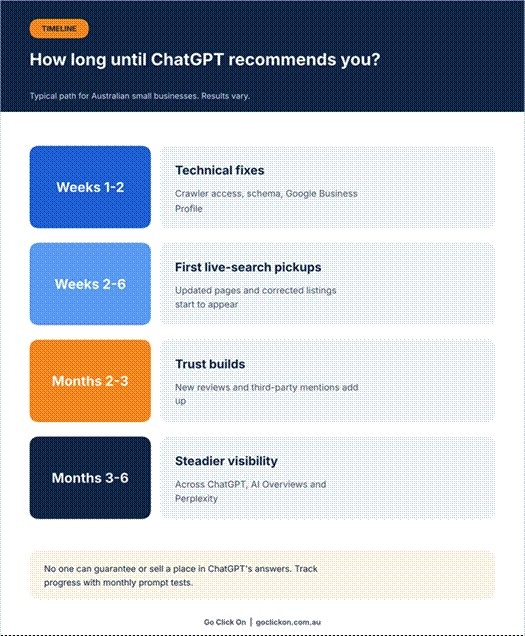
- Weeks 1 to 2. Complete the technical fixes, such as crawler access, schema and your Google Business Profile.
- Weeks 2 to 6. Updated pages and corrected listings start to appear in live search answers.
- Months 2 to 3. New reviews and third-party mentions gradually build up.
- Months 3 to 6. Visibility becomes steadier across ChatGPT, AI Overviews and Perplexity.
Live search can pick up changes within days, while what the model learned in training changes far more slowly, often only when a new version is released.
What you cannot control
ChatGPT answers change between users, devices and days, and location, prompt wording and previous conversations all play a part.
You also cannot pay for a place inside an organic answer, so be wary of anyone who guarantees a ChatGPT ranking. Ask how they will measure it, which prompts they will track and whether they will report bad results as well as good ones.
What you can control is the quality and consistency of your information, and that is where the real gains are.
Common mistakes we see on small business websites
- Accidentally blocking AI bots through a security plugin or hosting firewall.
- Hiding prices completely. Even a starting price or a range helps AI answer cost questions.
- Using one long Services page instead of a separate, clear page for each service.
- Leaving old addresses and phone numbers on directories after moving premises.
- Copying American content that mentions zip codes, US states or US regulations.
- Chasing one platform. The same work helps ChatGPT, Gemini, Perplexity and Google, so build once for all of them.
How Go Click On helps small businesses get recommended by AI
At Go Click On, we have built websites and run SEO for Australian businesses since 2010. We have delivered more than 1,000 websites and hold a 5.0-star rating on Google. Our AI SEO services cover AI SEO, AEO and GEO, so ChatGPT, Gemini, Perplexity and Google AI Overviews can understand and cite your business.
Web, marketing, IT support and cyber security all sit under one roof with us. When a firewall or hosting rule is blocking AI crawlers, our IT team can fix it without weakening your security. That is a gap many marketing-only agencies cannot close on their own.
We also know how niche authority works. We have supported more than 30 CRICOS and RTO institutes, including LMS and student management system integration with Wisenet, VETtrak and aXcelerate. The same approach helps any local business become the clear answer in its field.
If you would like to know where you stand today, book a free consultation with our Melbourne team. We will look at how AI tools see your business now and show you what to fix first.
Frequently asked questions
1. Can I pay to be recommended by ChatGPT?
No, there is no way to buy a spot inside ChatGPT’s organic answers. Recommendations come from what ChatGPT can find and check about your business across the web.
2. How do I find out if ChatGPT recommends my business?
Ask ChatGPT the questions your customers ask, such as “best [service] in [suburb]”. Use a private window, note the sources it links and repeat the test each month. Check Google AI Overviews and Perplexity too.
3. Does blocking GPTBot stop my business appearing in ChatGPT?
No. GPTBot collects content for model training, while OAI-SearchBot powers ChatGPT search. You can block GPTBot and still allow OAI-SearchBot.
4. How long does it take to get recommended by ChatGPT?
Technical and listing fixes can show up within days or weeks through live search. Steady visibility usually takes three to six months of consistent work.
5. Does this work for small local businesses?
Yes. Local businesses often do particularly well, because ChatGPT searches for providers in a set area where there are fewer strong competitors.
6. Is GEO the same as SEO?
They overlap but are not the same. SEO aims for Google rankings, while GEO aims for mentions in AI answers. Strong SEO makes GEO work easier.
7. Do I need an agency to get recommended by ChatGPT?
Not always. Most owners can handle reviews and directory clean-up in-house. An agency helps most with crawler access, schema, content structure and tracking.