
How much should small businesses spend on digital marketing in 2026-27?
Before they ask about SEO, ads or a new website, most owners I meet want one number. They want to know what a sensible digital marketing budget looks like for a business their size.
No single figure suits everyone. A plumber in Werribee and an online store that ships Australia-wide face very different costs. Still, there are clear benchmarks, and there is a simple way to land on a figure you can explain to your accountant.
This guide covers what Australian small businesses should spend in the 2026-27 financial year. You will find the revenue rules, what each channel costs, sample budgets and the hidden costs that catch people out. At Go Click On we have helped Melbourne businesses plan this since 2010, so the advice below comes from budgets we have built and run ourselves.
QUICK ANSWER
Most Australian small businesses should spend 5% to 12% of annual revenue on marketing in 2026-27, with most of it going to digital channels. New businesses, or those in crowded markets, often need 12% to 20% for the first year or two. In dollar terms, most small businesses spend $1,500 to $5,000 a month. If your budget is under $1,000 a month, put it into one channel and do that one well.
KEY TAKEAWAYS
- Budget 5% to 12% of annual revenue for marketing. Aim for 12% to 20% if you are new or in a crowded market.
- Most Australian small businesses spend $1,500 to $5,000 a month once agency fees and ad spend are added up.
- Fix your website, tracking and Google Business Profile before you pay for a single click.
- Google Ads can bring leads within weeks. SEO takes 4 to 12 months but keeps working when you stop paying.
- Set aside part of your SEO budget for AI search, since AI Overviews now cut clicks to websites by about half.
- Add the hidden costs, such as GST on ad spend, software, content and your own time.
- Review results every quarter and move money to the channel with the lowest cost per lead.
What percentage of revenue should a small business spend on digital marketing?
The most common benchmark is 5% to 12% of gross revenue for all marketing. For most of the small businesses we work with, digital channels now take the largest share of that figure.
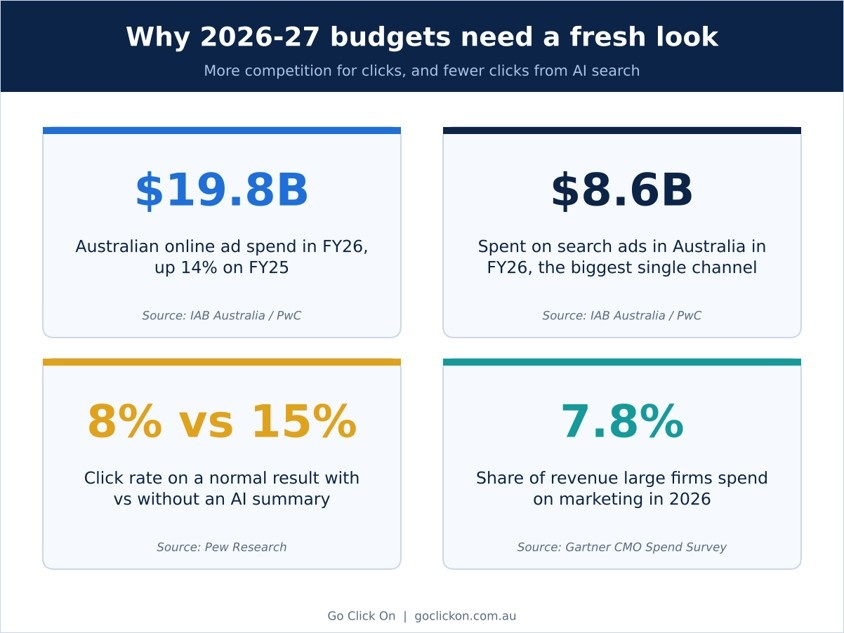
Big companies sit near the middle of that range. Gartner’s 2026 CMO Spend Survey found large firms spend 7.8% of revenue on marketing, up from 7.7% in 2025. Small businesses often need a higher share. They are building awareness from a low base, and they do not have a well-known brand doing the work for them.
Your stage of business decides where you sit in the range.
- If you are established with steady demand, 5% to 8% is usually enough to hold your position.
- If you are growing or launching a new service, 8% to 12% helps you build momentum.
- If you are under three years old or in a very crowded market, plan on 12% to 20% until enquiries are steady.
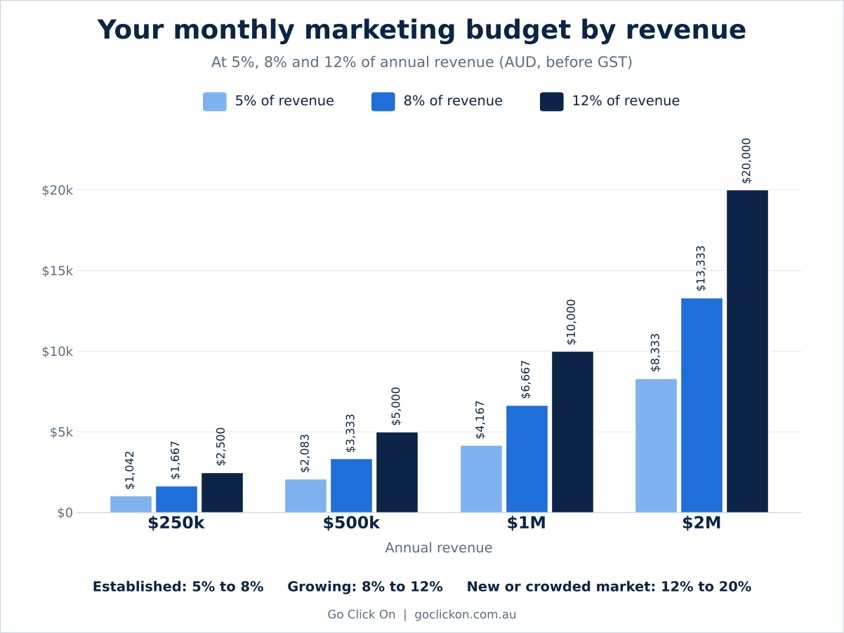
Here is what those percentages look like as a monthly budget.
| Annual revenue | 5% a month | 8% a month | 12% a month |
| $250,000 | $1,042 | $1,667 | $2,500 |
| $500,000 | $2,083 | $3,333 | $5,000 |
| $1,000,000 | $4,167 | $6,667 | $10,000 |
| $2,000,000 | $8,333 | $13,333 | $20,000 |
Australian small businesses also start behind. CPA Australia’s 2026 small business survey found only 68% use social media for business, against 88% across Asia-Pacific. Only 44% earn more than a tenth of their revenue online, against 63% in the region. If your competitors are slow online, a steady budget goes a long way.
Quick takeaway: Pick a percentage that matches your stage, then turn it into a monthly dollar figure you can commit to for 12 months.
Why your 2026-27 budget needs a fresh look
Two things have changed since most owners last set a marketing budget. More businesses are bidding for the same customers, and AI search now answers many questions before anyone clicks.
More competition for every click
Australian online ad spend hit $19.8 billion in FY26, up 14% on the year before, according to IAB Australia and PwC. Search alone took $8.6 billion. IAB noted that much of the new money came from small and medium businesses. More bidders in the auction usually means higher click prices.
Better pages can win back that cost. WordStream’s 2026 Google Ads benchmarks show the average cost per click rose to US5.42.TheaveragecostperleadfelltoUS66.69, because conversion rates improved. A fast, clear landing page is now one of the cheapest ways to stretch an ad budget.
AI search changes where the clicks go
A Pew Research study of nearly 70,000 Google searches found people clicked a normal result 8% of the time when an AI summary appeared. Without one, they clicked 15% of the time. Links inside the AI summary got clicked only about 1% of the time.
So your SEO budget should now cover AI search as well. That work is often called AEO or GEO. It means clear answers on your pages, FAQ schema, and the same business details everywhere online, so tools like Google AI Overviews, ChatGPT and Gemini can find and cite you.
Quick takeaway: Budget a little more for landing pages and AI search than you would have two years ago. Both protect you from rising click costs.
How much does digital marketing cost in Australia?
Here is what the main channels cost small businesses in 2026, based on published Australian price guides and the quotes we see across Melbourne. Use it to compare channels side by side before you split your budget.
| Channel | Typical cost (AUD) | Time to first results | Best for |
| Local SEO and Google Business Profile | $400 to $1,500 a month | 3 to 6 months | Trades, clinics and suburb-based services |
| Full SEO retainer (incl. AI search) | $1,500 to $5,000 a month | 4 to 12 months | Steady leads without paying per click |
| Google Ads spend | $1,000 to $5,000 a month | Days to weeks | Urgent, ready-to-buy searches |
| Google Ads management | $800 to $2,000 a month | Starts with the ads | Anyone without time to run ads well |
| Social media (content plus ads) | $1,000 to $5,000 a month | 1 to 3 months | Visual brands, events and local awareness |
| Email marketing | $50 to $400 a month for software | 2 to 6 weeks | Repeat customers and past enquiries |
| Website build (one-off) | $2,500 to $20,000+ | At launch | Every business, since all channels lead here |
Digital marketing costs for Australian small businesses in 2026-27
SEO prices in the table line up with Australian SEO pricing data, where most small business retainers sit between $2,500 and $3,500 a month. Prices outside these ranges are not always a red flag. Just ask exactly what you get for the money, and how results will be reported.
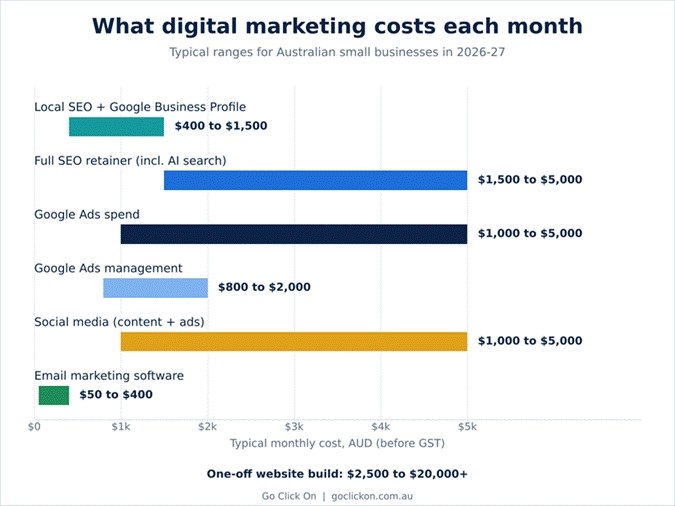
Typical monthly costs by channel for Australian small businesses
If you want help with a channel, our pages on local and organic SEO, Google Ads management and social media marketing explain what each one includes.
Quick takeaway: Use paid ads when you need leads quickly and SEO for leads that keep coming. Most small businesses need some of both, weighted to their cash flow.
How should you split a small business marketing budget?
Spend in this order. First, fix the things every channel depends on. Then capture people who are already searching for you. Only after that should you pay to build new demand.
- Fix the foundations first. That means a fast, mobile-friendly website, conversion tracking and a complete Google Business Profile.
- Capture people already searching, with Google Ads and SEO for terms like “electrician near me” or “NDIS provider Melbourne”.
- Build new demand with social media, video and content that reach people before they start searching.
- Keep the customers you win through email, reviews and follow-ups, which cost little and bring repeat sales.
Many businesses then use the 70/20/10 rule. Put 70% into channels that already work for you, 20% into channels that look promising, and 10% into small tests. Here is how that might look on a $3,000 monthly budget.
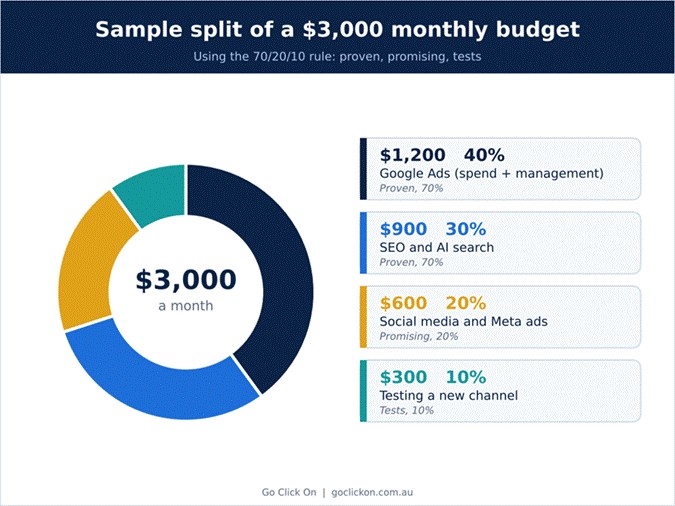
One warning on fees. If you pay an agency, check how much of each dollar actually reaches Google or Meta. A $2,000 plan with $1,500 in fees leaves only $500 for ads. In most local markets that is too little to learn what works.
Quick takeaway: Fix your foundations before you spend on demand. Ads that send people to a slow website with no tracking waste money.
Sample digital marketing budgets for 2026-27
These three examples show how the numbers work for different Australian businesses. They are illustrations rather than quotes, and each one follows the rules above.
| Business | Revenue and % | Monthly budget | Where the money goes |
| Electrician, Melbourne’s west | $400,000 at 7% | $2,333 | Local SEO and Google Business Profile $900, Google Ads $1,200, reviews and email $100, software $133 |
| Allied health clinic | $900,000 at 8% | $6,000 | SEO and content $2,200, Google Ads $2,000, Meta ads and social $1,200, website and tracking $350, email $250 |
| Online store, Australia-wide | $1,500,000 at 10% | $12,500 | Google Shopping and Performance Max $5,500, Meta ads $3,000, SEO and content $2,500, email and SMS $800, testing $700 |
Example monthly budgets (AUD, before GST)
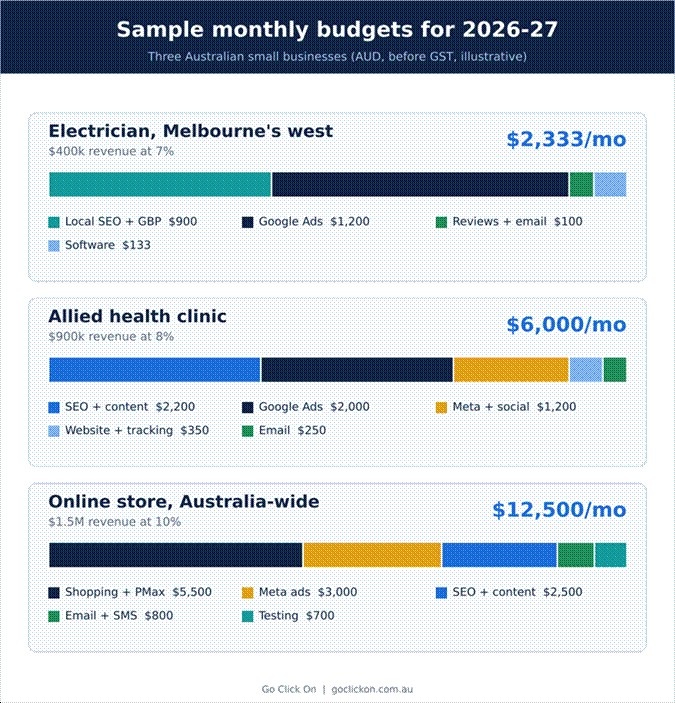
Notice that the electrician leans on local search, while the online store spends most on paid shopping ads. The right split follows how your customers buy.
Agency, freelancer, in-house or DIY? Comparing the real cost
Who runs your marketing affects the budget as much as the channels do. This comparison shows what each option really costs in 2026.
| Option | Typical cost | What you get | Watch out for |
| Do it yourself | Software only, plus your time | Full control and low cash cost | Hours away from paying work, and a slow learning curve |
| Freelancer | $80 to $200 an hour | Strong skills in one area | Gaps when they are busy or away |
| Agency | $1,500 to $8,000 a month | Several specialists on one bill | Long lock-in contracts and vague reports |
| In-house hire | About $74,000 a year base, plus 12% super | One person focused on your business | Hard for one person to cover SEO, ads, design and tech |
Comparison of ways to run small business digital marketing
A digital marketing specialist in Australia earns an average base salary of AU$74,322, with most between $55,000 and $101,000. Add super, leave and software, and one hire often costs more than a full agency team. For most businesses under $2 million in revenue, an agency or a skilled freelancer gives better value.
If you go with an agency, ask for month-to-month terms after the first few months. Ask for reports that show leads and sales alongside traffic.
Hidden costs to add to your budget
These are the costs owners most often leave out, and they can add 10% to 20% to the real bill.
- Google and Meta charge 10% GST on ad spend for Australian advertisers, so $1,000 in ads becomes a $1,100 bill.
- Google Analytics 4, conversion tracking and call tracking need a proper one-off setup.
- Email platforms, booking tools, SEO tools and a CRM each add a monthly fee.
- Ads and posts need photos, short videos and graphic design.
- Hosting, security updates and plugin licences keep your website fast and safe.
- Your own time counts too, since approving content, answering leads and joining review calls all take hours each month.
Quick takeaway: Build a 10% to 15% buffer into your budget for costs that sit outside the agency invoice.
How to build your 2026-27 digital marketing budget in five steps
- Decide how many new customers you need this financial year to hit your revenue target.
- Work out the average profit from one customer over the whole time they stay with you.
- Keep the cost to win a customer under a third of what that customer is worth.
- Match your percentage to your stage, fund the foundations, then pick one main channel and one support channel.
- Track cost per lead, conversion rate and revenue every quarter, then move money to what works.
Here is a quick example. Say a new customer is worth $3,000 to you over two years. You can afford to spend up to $1,000 to win them. If one in four leads becomes a customer, each lead can cost up to $250.
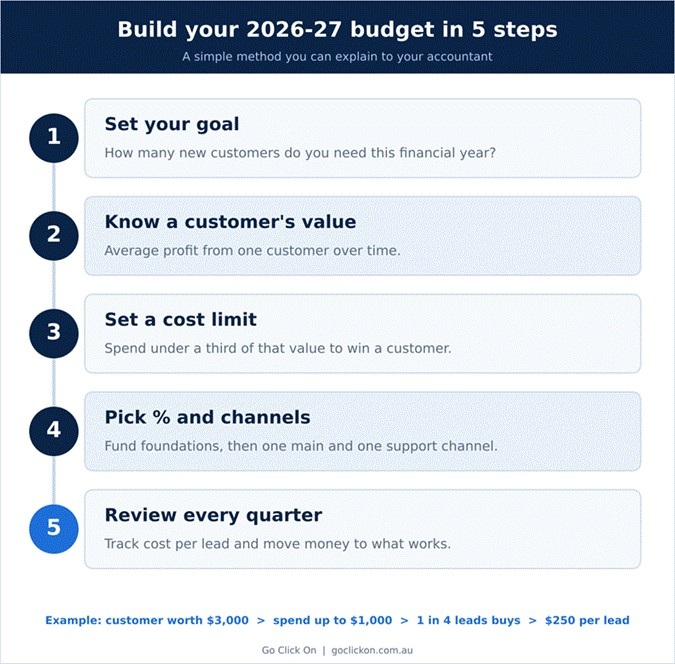
Give each channel enough time before you judge it. Allow 60 to 90 days for Google Ads to settle, and at least six months for SEO.
Increase your budget when your cost per lead is steady and you can handle more work. If one channel is clearly cheaper than the others, move money to it before you add more.
Common budgeting mistakes small businesses make
- Spreading a small budget across five channels, so none gets enough to work.
- Running ads to a slow website that has no conversion tracking.
- Stopping SEO after three months, just before it starts to pay off.
- Judging success on clicks and traffic instead of leads and sales.
- Signing a 12-month contract before seeing a single report.
How Go Click On helps you get more from your budget
Go Click On is a family-run Melbourne agency that has been helping businesses grow online since 2010. We have delivered more than 1,000 websites and hold a 5.0-star Google rating. We also support more than 30 CRICOS and RTO institutes across Australia.
Our team covers websites, SEO, AI search, paid ads, social media, IT support and cyber security under one roof. So one team can see how your website affects your ads and SEO results. We keep pricing transparent, with no hidden costs.
If you want a clear budget for 2026-27, book a free 60-minute consultation with our digital marketing team. We will look at your numbers and show you where each dollar should go. You can also contact us or call 1300 442 648.
Frequently asked questions
1. How much should a small business spend on digital marketing per month in Australia?
Most Australian small businesses spend $1,500 to $5,000 a month, including agency fees and ad spend. A business turning over $500,000 that spends 8% of revenue would budget about $3,333 a month.
2. Is 10% of revenue too much to spend on marketing?
No. 10% is normal for a business that wants to grow. Established businesses with steady demand often spend 5% to 8%, while new businesses may need 12% to 20%.
3. How much should a small business spend on Google Ads?
Most local businesses need $1,000 to $2,500 a month in ad spend to get enough clicks to learn from, plus management fees. Busy markets like law or finance usually need more, as clicks cost more.
4. Is SEO worth it for a small business on a tight budget?
Yes, if you can commit for at least six months. Start with local SEO and your Google Business Profile, which cost less and often bring the fastest organic gains for suburb-based businesses.
5. Should a new business spend more on marketing?
Yes. A new business has no reviews, rankings or word of mouth yet, so it often needs 12% to 20% of revenue in its first year or two. The share can drop as enquiries become steady.
6. How long does digital marketing take to show results?
Google Ads can bring leads within days. Social media usually takes one to three months, and SEO takes four to twelve months. Judge each channel against its own timeline.
7. Do small businesses need to budget for AI search in 2026-27?
Yes. AI Overviews and tools like ChatGPT now answer many searches directly. A small part of your SEO budget should go towards clear answers, FAQ schema and consistent business details so these tools can cite you.